Worst Case Scenario

I often think about things like, ‘What would I do if this train goes off the bridge and into the East River? How could I survive this?’ ‘If this plane starts to crash, could I land it?’ Insane, I know. I was thinking of starting a series: Insane Things I Thought Today.

But we had an earthquake not too long ago, and it must have freaked me out more than I realized, or maybe it dredged up 9/11 fears, but every once in a while I wonder what I would do if my building started to collapse. I’m pretty sure I’d be a goner, but the only thing I’ve come up with so far is to try to make it out the window and onto the fire escape. I figure less will be falling on top of me that way, and maybe more opportunities for saving myself will be presented when I get out there. I also realized that in the time given there’d be nothing I could do to save the cats. I can only hope since cats are good fallers they can take care of themselves.

Seriously though, or insanely though, I do feel like my building has been weakened. Is that possible? I swear it feels like it’s tilting more.

There happens to be a book about this very thing, which I own of course. It’s all about what to do if you find yourself in a number of precarious positions: The Worst-Case Scenario Survival Handbook.

I will always stop to take pictures of bubbles. This was on Broadway.

No One is Allowed to Talk About Singing for Four Months

Every time an article comes out about singing now I feel like someone has beaten me to the punch. Please, for the love of god editors and writers, I can’t take it. Can we call a moratorium on the subject until my book (Imperfect Harmony: Finding Happiness Singing With Others) comes out on July 2nd? Thank you in advance.

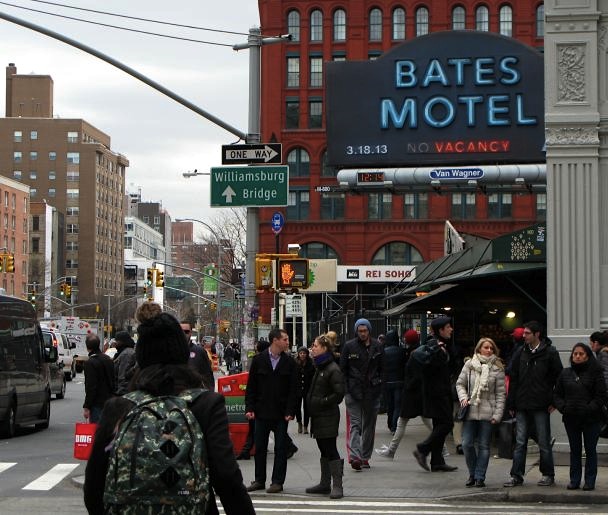
I enjoyed coming upon this ad yesterday for a new A&E tv show. It’s at Houston and Broadway. Not that I’m going to be adding any more shows to the list of shows I watch. There’s too much good stuff on tv to watch. (I was going to use an exclamation point in that sentence, but there’s been such an exclamation point backlash, I used italics instead.)

Bates Motel

Get on the Mediterranean Diet or DIE

Alright, we’re going to die anyway, but hopefully not for a really long time. I’m sure you’ve all read this article in the Times about the Mediterranean Diet, but I thought I’d post a link to it just in case. Get on this diet. It helps prevent the number one cause of death in America, cardiovascular disease.

“The study ended early, after almost five years, because the results were so clear it was considered unethical to continue.” Meaning, they felt like they were practically killing the people in the control group, who were eating some version of the standard American diet. All the researchers in the study are now on the Mediterranean diet. I was glad to read specifics about what the diet entails, because I’ve been hearing this for years, get on the Mediterranean diet, but what, exactly, is a Mediterranean diet? Based on this study, I think the only thing I need to do is eat more beans. I’m still confused about the difference between a bean and a legume, but apparently it doesn’t matter, you need to eat both. So anything small, round, and bean-ish I’m eating. Except lima beans. Which suck.

Here is the actual study from the New England Journal of Medicine.

I eat well and exercise for health reasons, mostly. But I’ve been trying to lose a pound. One pound. Yesterday I walked 4 miles, swam for about 3/4 of a mile—that’s more than what I normally do in a day, but I do exercise every day and walk everywhere I go so it’s not really all that much more than usual. I eat a vegetarian diet. Why don’t I weigh, like, 80 pounds? I should be practically invisible with the way I live. What’s a girl got to do to lose a pound?

This is looking west, on the corner of Hudson and Canal Streets.

Time Tripping

I’m not saying where this is because I’m afraid of getting in trouble. I know it’s very weird taking pictures in a public bathroom, but I just love the 19th century back-in-time feel of this room, and I swear that at the time no one was in there besides myself. Look at these wood doors, all the marble, the brass. And scroll down and check out the fire hose.

Maybe some of you see things like this all the time, but it looks like something we don’t even use anymore to me. Very steam punk.

Who sang it better: Maria Callas or Renata Tebaldi?

This post is inspired by Mavis’s recent comments about the sopranos Maria Callas and Renata Tebaldi, and who stayed on pitch. This was always (and maybe still is?) a huge debate, I gather. When I was researching the subject of audio forensics I learned about a fascinating experiment regarding this very question.

Briefly, the field of audio forensics began in the late fifties and early sixties when the NYPD asked scientists at Bell Labs for help identifying who was telephoning bomb threats to a number of airlines. Using something called a spectrograph, Dr. Lawrence Kersta made visual representations of the phone conversations. These pictures are called voiceprints. Kersta had assisted in their development during WWII, when the military was looking for ways to identify enemy voices over the radio.

Kersta pronounced voiceprints as distinctive and reliable as fingerprints for identifying people, and he left Bell Labs to form his own company. The field of audio forensics was born.

Kersta was involved in many famous cases in his lifetime, including the Kennedy assassination, the Clifford Irving Howard Huges hoax, and in 1969, when rumor spread that Beatle Paul McCartney was dead and replaced by a look and sound-alike, Kersta compared voiceprints from older recordings of McCartney to ones that were current and determined that Paul was very much alive.

But one interesting thing Kersta discovered was: people can be as unreliable about recalling what they heard as they are about what they saw. We know many people have been falsely convicted based on eye witness testimony. Apparently ear witness testimony can be just as iffy, and people don’t always hear what they think they heard.

I interviewed Tom Owen, an audio forensic examiner certified by the American College of Forensic Examiners. He was also once the Chief Engineer for the Rodgers and Hammerstein Archives at Lincoln Center. He told me how he used Kersta’s spectrograph to compare the high C’s of Maria Callas and Renata Tebaldi.

“Certain singers can hold a high C forever,” Owen told me, “but very few singers can hold the same pitch forever.” Owen made voice prints from recordings of each singer. “You can see that Tebaldi was right on the money … and Maria Callas was all over the place … she hit the note but she couldn’t hold the note. That’s forensics, it is what it is, whether it’s a singer or a killer or a ballistics thing, it is what it is … you’re showing what’s there.”

Of course Mavis’s larger point was, Tebaldi’s high C may have been pitch perfect, but Callas’s was more artful and beautiful.

One more thing, I visited the Bell Labs archives and the curator was kind enough to dig up an old Bell Labs promotional film called “Science Behind Speech.” This is Lawrence Kersta demonstrating what a spectrograph does.

A shot of conductor John Maclay and the orchestra and audience after one of the Choral Society of Grace Church concerts.